TIO Dehradun
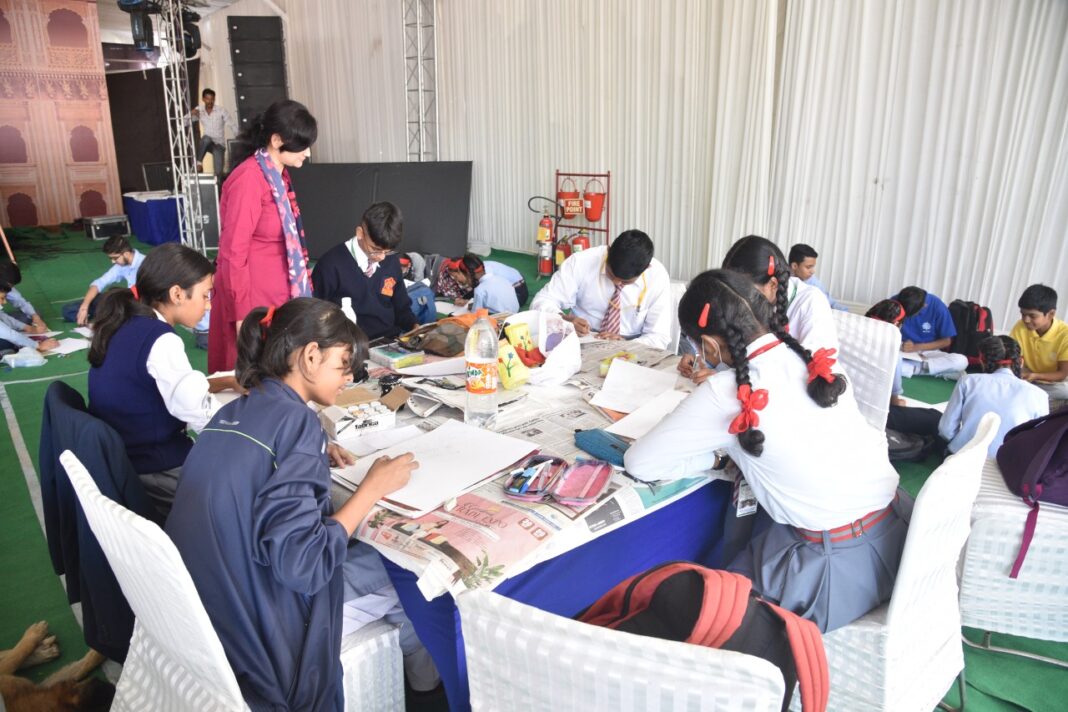
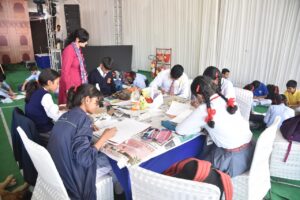
The 11th day of the Virasat Art and Heritage Festival 2022 began with ‘Virasat Sadhana’. A ‘Virasat Sadhana Painting Competition’ was organized, children from different schools participated in this competition. The theme of this painting competition was (Our Heritage) Hamara Dharohar. In this competition, 145 children from 16 schools participated and each child made different types of pictures. The competition lasted from 11:00 am to 1:30 pm. The result of this competition will be announced on 22nd October.
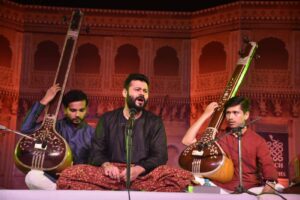
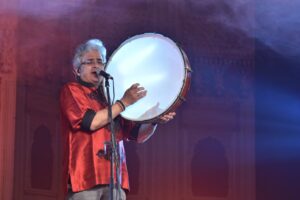
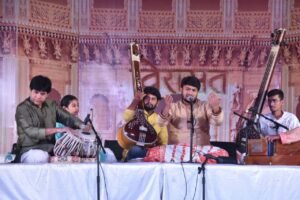
The cultural evening program started with the lighting of the lamp and classical music (vocal) was presented by Bhagyesh Marathe. Bhagyesh started his program with traditional khayal in Raag Maru Bihag. The delayed bandish was “Rasia Ho, Na Jao” and the quicker bandish was “Bawri Bhai Birhan”. His next performances were a bandish in the vilambit taal “Jiyara Ra, Kal Nahi Paave” in Raga Sohoni and the fast taal “Pyaara Menda Mazar Nahi Aawe”. He was accompanied by Pt. Mithilesh Jha on Tabla, Zakir Dholpuri on Harmonium, Shailesh Rawat on Tanpura and his disciple Sagar Chawriya also accompanied him on Tanpura.
Bhagyesh Marathe, born into a musical family, is the grandson of the great Indian classical singer Sangeet Bhushan Pandit Ram Marathe. His performance reflects his exuberant understanding of raga, developing a unique style of musical presentation. He started learning Tabla at the age of 4 and was accompanied by Shri Prabhu Ghate, his uncle Shri Mukund Marathe, Pt Mukundraj Dev and Shri Gajanan Raul (disciple of Ustad Allarkha Khan Sahab) for about 15 years.

Bhagyesh completed his bachelor’s degree in information technology from Mumbai, at the age of 19, while completing his second year of graduation. His father encouraged him to pursue a career in music. On the advice and insistence of his father, he started listening to the singing and songs of his grandfather and many other Indian classical singers. He was mesmerized by the style of singing of his grandfather Pt Kumar Gandharva. And he was so impressed that he decided to take up singing as his profession. He started learning music under the guidance of his father Pt. Sanjay Marathe, he further mastered his talent with Pt Kedar Boda.
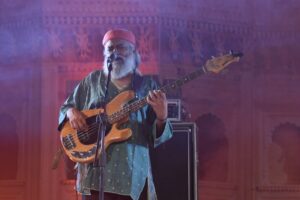
In other presentations of the cultural program, Indian Ocean Bad gave its performance. The Indian Ocean has made a name for the unconventional voice and democratic values of the society in the last 33 years. Today they sang some unreleased songs from his upcoming album. His song, “Sarpat aaya kaisa khokhala zamana re.” from the upcoming movie “Chakki” written by Piyush Mishra was a huge hit among the people. He sang many of his old and popular songs including from the movie “Masaan” which rocked the stage and delighted all the audience present in Virasat.
Indian Ocean Bad is an Indian rock band formed in New Delhi in 1990, widely popular in India for its fusion rock genre. This band mainly consists of Nikhil Rao, Amit Kilam, Rahul Ram, Himanshu Joshi and Tuhin Chakraborty.
The band’s musical style can best be classified as folk and fusion music. It is an experimental style, mixing ragas (traditional Indian tunes) with rock music, guitar and drums, sometimes using Indian folk songs. It has been described by some music critics as “Indo-rock fusion with jazz-spicy rhythms that integrates slang, Sufism, environmentalism, mythology and revolution”.
Since 2010, the band has followed the lines of the record label. He released his album “16/330 Khajoor Road” online for free. He is also part of the world’s first music personalization initiative called DRP as one of five featured artists. They are on the list of “The 25 Greatest Indian Rock Songs of the Last 25 Years”, featuring two songs in “Rolling Stone India”, Ma Rewa and Kandisa from the album, Kandisa (2000).
Several aspects make Indian Ocean Bad unique. One is its sound, which blends Indian folk and semi-classical roots with rock and jazz inflection. With its core audience growing on both Indian and Western music, it was easy to be by a mix of traditional and contemporary.
Indian Ocean Bad can be described as a leader of non-film Indian-language rock-based music, something that has evolved into today’s independent music landscape after two decades.